Sunday, September 27, 2015

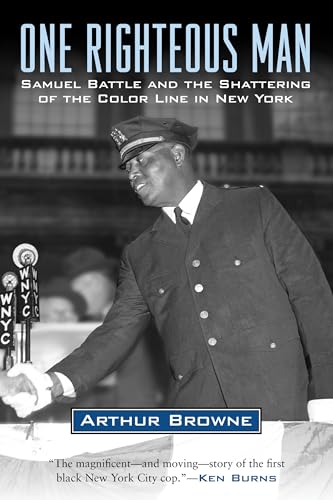
One Righteous Man: Samuel Battle and the Shattering of the Color Line in New York, by Arthur Browne


I read this book in June of this year, reviewed it on LibraryThing, and was shocked to see that I hadn't cross-posted it here! I still have it in my possession; I have not yet heard from Alabama State University. I will contact them again.

A biography of Samuel Battle, the first African American police officer in New York City, in 1911, and the challenges he faced getting on the force and fighting for each promotion and honor. He faced not only racial discrimination, but also Tammany Hall and organized crime.
This is also a story of race relations in the early years of the 20th century in the United States. What surprised me: (1) that the civil rights struggle did not begin in the 1950s; it began when the first shipload of African slaves was brought to what was then called the New World, and (2) that prejudice and discrimination was and is a national problem, not only a southern problem.
This book gave a fair and balanced account of Samuel Battle's life and behavior, revealing flaws as well as his many righteous and heroic deeds. We also see his personal life, a strong, loving husband and father, a man of faith, and a leader in his neighborhood and community.
This book is well documented and well researched, relying not only on Mr. Battle's own words in a manuscript written by Langston Hughes, but also citing public records and newspapers of the day. It has an extensive Notes section, as well as a very helpful Index.
I will try to donate this book to the Alabama State University, a historically black school in my hometown of Montgomery, Alabama. Mr. Battle's story should be shared with all who are interested in racial relations and in civil rights.

Wednesday, September 23, 2015

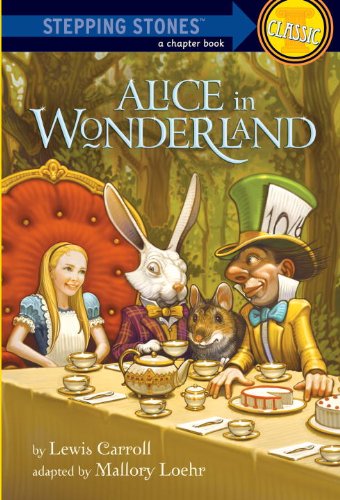
Happy Anniversary, Alice in Wonderland!


stock photo courtesy of Abe Books

I saw this note on Abe Books' Facebook page: "Alice's Adventures in Wonderland is a book loved by many and this year it celebrates its 150th anniversary. Learn about the author, the story, the illustrators and more on AbeBooks."

On the website linked below: "Lewis Carroll's Alice's Adventures in Wonderland, a story about a curious girl who falls down a rabbit hole and discovers a magical, nonsensical world, celebrates its 150th anniversary in 2015. Read by millions of children and adults alike around the world, this iconic book has been translated into at least 97 different languages and continues to be published in various forms. "

Read more here: Abe Books celebrates Alice in Wonderland

I have to say, of all the illustrators whose works are sampled in the website, I greatly prefer the original, John Tenniel, and also the Disney version (not pictured on the site). That was the Alice I grew up with, the little blond girl with a blue dress and white pinafore!

Did you read and enjoy Alice in Wonderland and Alice Through the Looking-Glass when you were a child? Have you read it since becoming an adult? I read it as a child, loved it then, and loved it again when I read it to my children!
Happy Anniversary, Alice!

Saturday, September 12, 2015

Two books I want to read

I have discovered two books online that I would like to read.

One is an account I read on Facebook of the actions of the kind and generous citizens of Gander, Newfoundland, Canada, on September 11, 2001. Airplanes from all over the world were landing at their airport, and travelers were temporarily stranded for several days, as there were no flights into or out of the United States following the attacks.
The Day the World Came to Town

The other is from an article in The History Blog about Emily Post, When Emily Post Drove From Sea to Shining Sea .

The book is By Motor to the Golden Gate . It is available online only; it has been digitized.

Tuesday, September 8, 2015

English Fairy Tales


fairy tale image courtesy of Stock Vector Illustration, from Shutterstock, copyright lukeruk

With thanks to my friend Carrie of Reading to Know for the links.

Do you enjoy reading fairy tales for yourself or to share with children? Some of these may be more appropriate for older children, as the endings aren't always happy.

Here is one called Molly Whuppie and the Double Faced Giant Slightly reminiscent of Hansel and Gretel and Jack and the Beanstalk, but significantly different.

For more stories, see the Table of Contents on the left side of the The Baldwin Project site, linked above. One might spend a few satisfying hours on this site!

Saturday, September 5, 2015

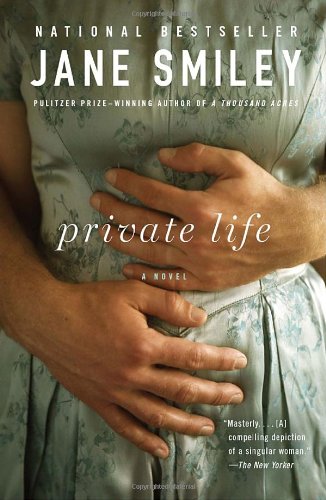
Private Life, by Jane Smiley


This book is a novel about Margaret Mayfield Early's life, spanning the era from 1883, when she was a young girl, to 1942. Her parents remembered vividly the American Civil War, and she lived through the Spanish-American War and World Wars I and II. (To be honest, World War II had just begun when Private Life ends, but Margaret is still strong and healthy.)

At 27 years, Margaret Mayfield is not beautiful nor especially talented. Her younger sisters marry and begin rearing families. It seems that Margaret is destined to remain an old maid - until Captain Andrew Early comes along. He doesn't exactly sweep her off her feet; his interest in her seems amazingly cool and indifferent, but she accepts his proposal. He is of a respectable family; his mother is a friend of her mother and he is always well groomed, and not unattractive. He has written a book concerning his theories of the universe, which has caught everyone's attention. It is only later, much later, that Margaret discovers that he has also caught unfavorable attention from his superiors and others at the university where he taught, and was forced to leave suddenly.

Immediately after their marriage, Andrew and Margaret move to California from Missouri, where Margaret has lived all her life. Taking an interest in her new surroundings, making friends and joining women's groups, Margaret is not homesick or bored. Time passes, and their hopes for a large family of strong, lively sons is thwarted. She grows less enchanted with her husband, as unsettling truths are slowly revealed, and his overbearing personality becomes more pronounced. She finds her time at home alone, when he is at work or engrossed in his projects, are a relief.

Margaret's old friend Dora (her sister's sister-in-law) has remained a busy, single career woman, traveling all over the world as a newspaper reporter. Although it is never expressed overtly, it seems that Margaret is envious of Dora's freedom. Although, actually Margaret is surprisingly free to come and go as she pleases, for a woman of her time. Her husband purchased an automobile, but insisted that she, not he, be the one to learn to drive it. She roams all over her small city and the county, and into San Francisco, observing nature and visiting friends which include a Japanese family and a Russian ex-patriot.

The Prologue and the Epilogue take in place in 1942, after the bombing of Pearl Harbor. These sections deal with the aftermath, especially the detainment and internment of Japanese families, Margaret's friends particularly.

Monday, August 24, 2015

Night Ride Home, by Vicki Covington


I have mixed emotions about this book. It was fairly interesting to read, but none of the characters really "grabbed" me. What I liked best about it, I think, is that it was set near Birmingham, Alabama, where I lived for 34 years. I recognized many of the places, and the one trip into the city was particularly interesting for that reason.

Set in a coal mining community in Jefferson County, Alabama west of Birmingham, this is a story of the events before and during a mining disaster.

Keller is about to marry Laura, the daughter of the owners of a service station and general store, against her father's wishes. Her mother manages the store, and her father works occasionally at the nearby steel mill, but mostly just hangs around the store drinking, shooting clay pigeons, "skeets," and getting drunker and angrier by the hour. He threatens his future son-in-law with a shotgun, so they secretly delay the wedding by a day. As it turns out, the new wedding date is December 7, 1941. However, the Pearl Harbor attack and World War II are only mentioned in passing. The young man, Keller, is afraid he will have to go to war.

On Christmas Eve that year, a wall falls at the No. 3 mine, trapping Keller's father and his crew. Men work around the clock, trying to dig them out. Meanwhile, Keller's mother fulfills a singing engagement at the Catholic Church in Birmingham, and the pregnant camp prostitute goes into labor. (The identity of the baby's father is the topic of much gossip and speculation in the community.)

Vicki Covington and her husband Dennis Covington live and work in Birmingham, Alabama. Both are authors and have been newspaper columnists.

Friday, August 21, 2015

A Child Who Reads ...


This image courtesy of www.birthdaywishes.expert

"A child who reads will be an adult who thinks." I am a strong believer in reading to children, teaching them to read, and encouraging them to read. I have always loved to read. My parents read to me at bedtime. I tried to learn to read before I started school, and managed to read and write a few words. Once I started reading books on my own, there was no stopping me!

I read to my children, and enjoyed it as much as they did. Even after they were reading independently, I read books aloud to them that were a little more advanced than their reading levels, and books that they might not have chosen. I have two sons, and we read Alice in Wonderland and The Wizard of Oz, books they might have passed over, as they featured girls as lead characters.

They are grown now. One of them loves to read as much as I do. The other not so much; he prefers watching TV (as my husband does). He does read to his children, and encourages them to read, so the torch is being passed. With so many other temptations: computers, TV, Leapfrog, etc., I do hope my grandchildren will be readers. There is nothing like reading!

Friday, August 14, 2015

Forgotten Bookmarks, by Michael Popek


This was sent to me by another Bookcrosser as part of a bookray. There had been some discussion about it on a Bookcrossing forum.

This is a compilation of strange things people have left in books to mark their places, from the early 19th century to the present day. It includes a very brief introduction, and lots of photos, all compiled by the author, a used book dealer and blogger.

I have barely started it, and am looking forward to delving further into it. When I am finished, I will send it on to the next Bookcrosser on the list.
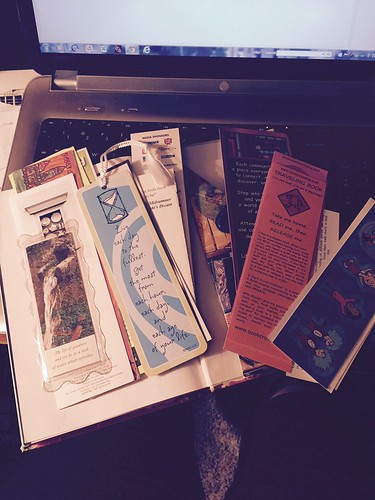
It comes with its own collection of bookmarks, generously supplied by the one who started the bookray, and others exchanged along the way. I have added two, and removed two.


Bookmarks

Monday, August 3, 2015

Bookish quote

"Sometimes you read a book so special that you want to carry it around with you for months after you’ve finished just to stay near it."

Markus Zusak, author of The Book Thief

(Bookish quote, seen on Bookcrossing.com)

Saturday, August 1, 2015

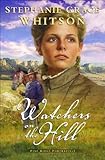
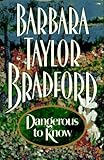
2 books: Watchers on the Hill, and Dangerous to Know


I finished it a few days ago. Written by Stephanie Grace Whitson, this is a Christian romance book of pioneer, ranching, and U. S. Cavalry days on the American frontier. A widow returns to her father's home to make a new life for herself and her wayward son. Romance beckons.
This book is the second in a series. While it could have stood alone successfully, there were too many annoying references to earlier times. (I have not read the first of the series.) However, it was a pleasant way to pass time.


Another romance, not Christian, written by Barbara Taylor Bradford. I started it yesterday, and am not liking the "spicy" passages. However, I probably will keep reading, just to find out who killed the old man. (Not a spoiler; we learn of his death on the first page.)

August 2 - On second thought, I won't finish it. I'll flip to the back to see how it ends, but I don't think I can swallow any more.

Sunday, July 26, 2015

Eighty-five year old man learns to read!

Lessons in Literacy, WSFA-TV news

I found this very interesting, and encouraging! Fred Oliver is the oldest person learning to read with the Literacy Council of Central Alabama! He wants to write a book about his life, and I want to read it. :-)

Mr. Oliver's advice to older people who need help learning to read: "Get out from in front of the TV and come to school," he said, then continued with, "You missed out? So you missed out. You can't reach back and get what you lost, but you can better your life at any stage."

Tuesday, July 21, 2015


This is a cartoon I found on Facebook, where it was attributed to Crown Publishing Group. I apologize if it is not public domain. If you own it, let me know and I will take it down.

Monday, July 20, 2015

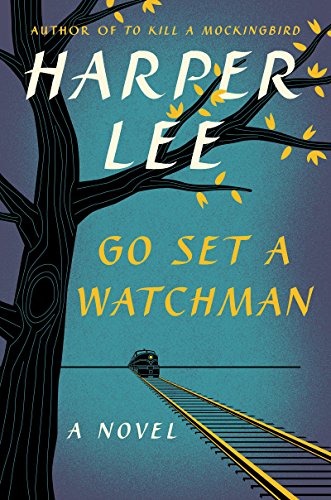
[SPOILER ALERT!!} Go Set a Watchman, by Harper Lee


Do not read this review if you don't want spoilers!!!

**************************************************

*****************************************

***********************************

******************************


I posted a "teaser" a few days ago, Redeemed My Voucher, so now that I've finished reading it, here goes!

This could have been titled, "Atticus' Feet of Clay". Like Jean Louise/Scout, many of us, most of us, regarded the Atticus Finch of To Kill a Mockingbird as a saint, a hero, an idol to look up to, a breath of fresh air in a stiflingly racist small town in the American South.

In Go Set a Watchman, he loses his virtue. The grown up Jean Louise witnesses him in the Maycomb County Courthouse, in the very room where he defended Tom Robinson so long ago, apparently complicit with the "Citizens Council" opposing the U. S. Supreme Court decision of 1954, the Brown vs the Board of Education decision that was decided in the early days of the Civil Rights Movement. At this meeting, racial epithets were thrown about. African Americans were reviled, reduced to children, reduced to animals, subhuman. Shameful, insupportable. Who was Atticus Finch that he could sit in that meeting and tolerate such as that?

Atticus was neither purely saintly nor purely evil.. Like all of us, he was a human, complete with fault and goodness, all mixed together. He was a good man, a fair man, but a man of his own time and place. That time was early to mid 20th century, and that place was Maycomb, Alabama, a small town in a rural county, many of whose citizens vividly remembered or knew relatives who remembered slavery, the Civil War, Reconstruction.
Atticus did not like all the things that were said at that meeting, but he saw the Supreme Court decision much as he saw the Civil War, aggression of the North against the South, a violation of the Tenth Amendment of the U. S. Constitution, the amendment guaranteeing States' Rights. Like many who considered themselves just and honorable people, he was for fair and equal treatment of all, but not in the same place, in the same schools, in the same restaurants, in the same seats on buses. He believed in the ideal "separate but equal", but we know that in reality "separate" was never "equal."

Jean Louise had a very heated and emotional confrontation with her old beau Henry, and another even more heated and emotional confrontation (on her part) with her father. I won't reveal the ending; I've "spoiled" you enough.

Now, my thoughts about the book itself. I thought it was very well written; in my opinion it lives up to the standards (if not the morals) of To Kill a Mockingbird. The characters are well drawn and the plot is interesting, with a great deal of conversation between individuals.

Comparing GSAW with TKAM: Jem has tragically passed away at a young age from a congenital heart disease. Dill is living in Europe, and Boo is no longer present. The old Finch home has been torn down and an ice cream shop is in its place. Atticus is now 72 years old and suffering from rheumatoid arthritis. Calpurnia has retired and lives with her family; Aunt Alexandra has come to live and cook and keep house for her brother Atticus. Scout (Jean Louise) is living in New York City and comes home for annual visits.

There were some discrepancies from the plot of TKAM that I found unsettling, even jarring. Since To Kill a Mockingbird was published and widely read and filmed decades, half a century, before Go Set a Watchman was released, I am treating it as the authority, even though Go Set a Watchman was actually written earlier.
Atticus did see his children in the courtroom as they viewed the Robinson trial from the balcony.
Tom Robinson damaged his arm while working in a cotton gin, not a sawmill.
Mayella Ewell was nineteen years old, not fourteen, a significant difference.
Atticus Finch was appointed to try Tom Robinson by Judge Taylor, not persuaded by Calpurnia, his cook/housekeeper. He accepted as a matter of conscience.
Most important of all, Tom Robinson was convicted, not acquitted.

All in all, I enjoyed the book and am glad I read it, notwithstanding the fall from grace of Atticus Finch. I was born and reared in the South, in Alabama in fact. I grew up with people who thought and spoke as the "new" Atticus did, and even as Aunt Alexandra and as Mr. O'Hanlon did. I came to see the world differently, and in college I had "words" with my parents as Jean Louise did with her father, but I included this to say that Atticus is a believable southern man of the 1950s, more moderate in his thinking than most of his contemporaries were, but certainly not up to progressive standards of the 2010s.
Saturday, July 18, 2015

Killer Keepsakes, by Jane K. Cleland


Cover image courtesy of LibraryThing

A delightfully well-written cozy mystery featuring the owner of a quaint New Hampshire antique shop and auction house. Her small group of employees are like family, so it is especially upsetting when her friend and assistant has not returned from work after her Hawaiian vacation. Even more distressing is the sight of a dead man on the missing woman's living room sofa! The plot twists and turns, with mysterious callers and secret identities before the answers are finally revealed.
(This book is fourth in a series, but stands alone very well. I have not read the others, and had no problem following this.)

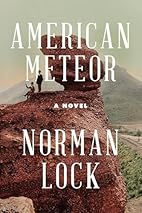
American Meteor, by Norman Lock


"American Meteor" could describe the protagonist of this novel, Stephen Moran, or the railroads that spanned the continent, or the US's declared "Manifest Destiny", or even Walt Whitman (quoted in the frontispiece "What am I myself but one of your meteors?"

Fast moving as a meteor, this brief novel (201 pages) encompasses the career of one man, and takes us from his childhood gathering oysters near Brooklyn, NY, to the American Civil War and an army hospital where he met Walt Whitman, to Abraham Lincoln's funeral train. He stayed with the train after the Union Pacific RR bought it, and having become enamored of the pioneer craft of photography, worked for U. P.'s Dr. Thomas Durant documenting the progress of the railroad's westward expansion. From there, it was a short step to becoming Gen. Custer's personal photographer, and meeting Crazy Horse..

The author takes a few liberties with actual historical events, as he freely admits in "Acknowledgements".