Do not read this review if you don't want spoilers!!!
**************************************************
*****************************************
***********************************
******************************
I posted a "teaser" a few days ago,
Redeemed My Voucher, so now that I've finished reading it, here goes!
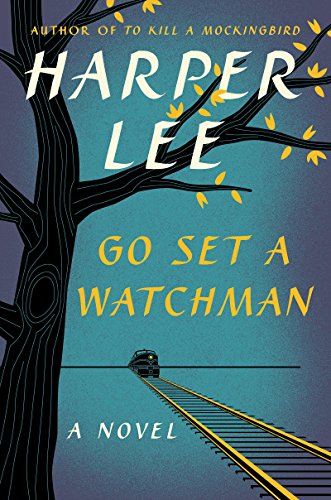
This could have been titled, "Atticus' Feet of Clay". Like Jean Louise/Scout, many of us, most of us, regarded the Atticus Finch of To Kill a Mockingbird as a saint, a hero, an idol to look up to, a breath of fresh air in a stiflingly racist small town in the American South.
In Go Set a Watchman, he loses his virtue. The grown up Jean Louise witnesses him in the Maycomb County Courthouse, in the very room where he defended Tom Robinson so long ago, apparently complicit with the "Citizens Council" opposing the U. S. Supreme Court decision of 1954, the Brown vs the Board of Education decision that was decided in the early days of the Civil Rights Movement. At this meeting, racial epithets were thrown about. African Americans were reviled, reduced to children, reduced to animals, subhuman. Shameful, insupportable. Who was Atticus Finch that he could sit in that meeting and tolerate such as that?
Atticus was neither purely saintly nor purely evil.. Like all of us, he was a human, complete with fault and goodness, all mixed together. He was a good man, a fair man, but a man of his own time and place. That time was early to mid 20th century, and that place was Maycomb, Alabama, a small town in a rural county, many of whose citizens vividly remembered or knew relatives who remembered slavery, the Civil War, Reconstruction.
Atticus did not like all the things that were said at that meeting, but he saw the Supreme Court decision much as he saw the Civil War, aggression of the North against the South, a violation of the Tenth Amendment of the U. S. Constitution, the amendment guaranteeing States' Rights. Like many who considered themselves just and honorable people, he was for fair and equal treatment of all, but not in the same place, in the same schools, in the same restaurants, in the same seats on buses. He believed in the ideal "separate but equal", but we know that in reality "separate" was never "equal."
Jean Louise had a very heated and emotional confrontation with her old beau Henry, and another even more heated and emotional confrontation (on her part) with her father. I won't reveal the ending; I've "spoiled" you enough.
Now, my thoughts about the book itself. I thought it was very well written; in my opinion it lives up to the standards (if not the morals) of To Kill a Mockingbird. The characters are well drawn and the plot is interesting, with a great deal of conversation between individuals.
Comparing GSAW with TKAM: Jem has tragically passed away at a young age from a congenital heart disease. Dill is living in Europe, and Boo is no longer present. The old Finch home has been torn down and an ice cream shop is in its place. Atticus is now 72 years old and suffering from rheumatoid arthritis. Calpurnia has retired and lives with her family; Aunt Alexandra has come to live and cook and keep house for her brother Atticus. Scout (Jean Louise) is living in New York City and comes home for annual visits.
There were some discrepancies from the plot of TKAM that I found unsettling, even jarring. Since To Kill a Mockingbird was published and widely read and filmed decades, half a century, before Go Set a Watchman was released, I am treating it as the authority, even though Go Set a Watchman was actually written earlier.
Atticus did see his children in the courtroom as they viewed the Robinson trial from the balcony.
Tom Robinson damaged his arm while working in a cotton gin, not a sawmill.
Mayella Ewell was nineteen years old, not fourteen, a significant difference.
Atticus Finch was appointed to try Tom Robinson by Judge Taylor, not persuaded by Calpurnia, his cook/housekeeper. He accepted as a matter of conscience.
Most important of all, Tom Robinson was convicted, not acquitted.
All in all, I enjoyed the book and am glad I read it, notwithstanding the fall from grace of Atticus Finch. I was born and reared in the South, in Alabama in fact. I grew up with people who thought and spoke as the "new" Atticus did, and even as Aunt Alexandra and as Mr. O'Hanlon did. I came to see the world differently, and in college I had "words" with my parents as Jean Louise did with her father, but I included this to say that Atticus is a believable southern man of the 1950s, more moderate in his thinking than most of his contemporaries were, but certainly not up to progressive standards of the 2010s.