Monday, August 24, 2015

Night Ride Home, by Vicki Covington


I have mixed emotions about this book. It was fairly interesting to read, but none of the characters really "grabbed" me. What I liked best about it, I think, is that it was set near Birmingham, Alabama, where I lived for 34 years. I recognized many of the places, and the one trip into the city was particularly interesting for that reason.

Set in a coal mining community in Jefferson County, Alabama west of Birmingham, this is a story of the events before and during a mining disaster.

Keller is about to marry Laura, the daughter of the owners of a service station and general store, against her father's wishes. Her mother manages the store, and her father works occasionally at the nearby steel mill, but mostly just hangs around the store drinking, shooting clay pigeons, "skeets," and getting drunker and angrier by the hour. He threatens his future son-in-law with a shotgun, so they secretly delay the wedding by a day. As it turns out, the new wedding date is December 7, 1941. However, the Pearl Harbor attack and World War II are only mentioned in passing. The young man, Keller, is afraid he will have to go to war.

On Christmas Eve that year, a wall falls at the No. 3 mine, trapping Keller's father and his crew. Men work around the clock, trying to dig them out. Meanwhile, Keller's mother fulfills a singing engagement at the Catholic Church in Birmingham, and the pregnant camp prostitute goes into labor. (The identity of the baby's father is the topic of much gossip and speculation in the community.)

Vicki Covington and her husband Dennis Covington live and work in Birmingham, Alabama. Both are authors and have been newspaper columnists.

Friday, August 21, 2015

A Child Who Reads ...


This image courtesy of www.birthdaywishes.expert

"A child who reads will be an adult who thinks." I am a strong believer in reading to children, teaching them to read, and encouraging them to read. I have always loved to read. My parents read to me at bedtime. I tried to learn to read before I started school, and managed to read and write a few words. Once I started reading books on my own, there was no stopping me!

I read to my children, and enjoyed it as much as they did. Even after they were reading independently, I read books aloud to them that were a little more advanced than their reading levels, and books that they might not have chosen. I have two sons, and we read Alice in Wonderland and The Wizard of Oz, books they might have passed over, as they featured girls as lead characters.

They are grown now. One of them loves to read as much as I do. The other not so much; he prefers watching TV (as my husband does). He does read to his children, and encourages them to read, so the torch is being passed. With so many other temptations: computers, TV, Leapfrog, etc., I do hope my grandchildren will be readers. There is nothing like reading!

Friday, August 14, 2015

Forgotten Bookmarks, by Michael Popek


This was sent to me by another Bookcrosser as part of a bookray. There had been some discussion about it on a Bookcrossing forum.

This is a compilation of strange things people have left in books to mark their places, from the early 19th century to the present day. It includes a very brief introduction, and lots of photos, all compiled by the author, a used book dealer and blogger.

I have barely started it, and am looking forward to delving further into it. When I am finished, I will send it on to the next Bookcrosser on the list.
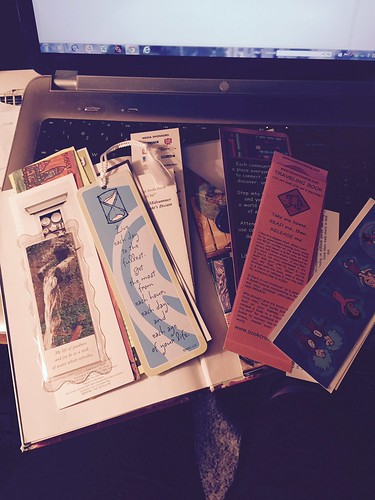
It comes with its own collection of bookmarks, generously supplied by the one who started the bookray, and others exchanged along the way. I have added two, and removed two.


Bookmarks

Monday, August 3, 2015

Bookish quote

"Sometimes you read a book so special that you want to carry it around with you for months after you’ve finished just to stay near it."

Markus Zusak, author of The Book Thief

(Bookish quote, seen on Bookcrossing.com)

Saturday, August 1, 2015

2 books: Watchers on the Hill, and Dangerous to Know


I finished it a few days ago. Written by Stephanie Grace Whitson, this is a Christian romance book of pioneer, ranching, and U. S. Cavalry days on the American frontier. A widow returns to her father's home to make a new life for herself and her wayward son. Romance beckons.
This book is the second in a series. While it could have stood alone successfully, there were too many annoying references to earlier times. (I have not read the first of the series.) However, it was a pleasant way to pass time.


Another romance, not Christian, written by Barbara Taylor Bradford. I started it yesterday, and am not liking the "spicy" passages. However, I probably will keep reading, just to find out who killed the old man. (Not a spoiler; we learn of his death on the first page.)

August 2 - On second thought, I won't finish it. I'll flip to the back to see how it ends, but I don't think I can swallow any more.

Sunday, July 26, 2015

Eighty-five year old man learns to read!

Lessons in Literacy, WSFA-TV news

I found this very interesting, and encouraging! Fred Oliver is the oldest person learning to read with the Literacy Council of Central Alabama! He wants to write a book about his life, and I want to read it. :-)

Mr. Oliver's advice to older people who need help learning to read: "Get out from in front of the TV and come to school," he said, then continued with, "You missed out? So you missed out. You can't reach back and get what you lost, but you can better your life at any stage."

Tuesday, July 21, 2015


This is a cartoon I found on Facebook, where it was attributed to Crown Publishing Group. I apologize if it is not public domain. If you own it, let me know and I will take it down.

Monday, July 20, 2015

[SPOILER ALERT!!} Go Set a Watchman, by Harper Lee


Do not read this review if you don't want spoilers!!!

**************************************************

*****************************************

***********************************

******************************


I posted a "teaser" a few days ago, Redeemed My Voucher, so now that I've finished reading it, here goes!

This could have been titled, "Atticus' Feet of Clay". Like Jean Louise/Scout, many of us, most of us, regarded the Atticus Finch of To Kill a Mockingbird as a saint, a hero, an idol to look up to, a breath of fresh air in a stiflingly racist small town in the American South.

In Go Set a Watchman, he loses his virtue. The grown up Jean Louise witnesses him in the Maycomb County Courthouse, in the very room where he defended Tom Robinson so long ago, apparently complicit with the "Citizens Council" opposing the U. S. Supreme Court decision of 1954, the Brown vs the Board of Education decision that was decided in the early days of the Civil Rights Movement. At this meeting, racial epithets were thrown about. African Americans were reviled, reduced to children, reduced to animals, subhuman. Shameful, insupportable. Who was Atticus Finch that he could sit in that meeting and tolerate such as that?

Atticus was neither purely saintly nor purely evil.. Like all of us, he was a human, complete with fault and goodness, all mixed together. He was a good man, a fair man, but a man of his own time and place. That time was early to mid 20th century, and that place was Maycomb, Alabama, a small town in a rural county, many of whose citizens vividly remembered or knew relatives who remembered slavery, the Civil War, Reconstruction.
Atticus did not like all the things that were said at that meeting, but he saw the Supreme Court decision much as he saw the Civil War, aggression of the North against the South, a violation of the Tenth Amendment of the U. S. Constitution, the amendment guaranteeing States' Rights. Like many who considered themselves just and honorable people, he was for fair and equal treatment of all, but not in the same place, in the same schools, in the same restaurants, in the same seats on buses. He believed in the ideal "separate but equal", but we know that in reality "separate" was never "equal."

Jean Louise had a very heated and emotional confrontation with her old beau Henry, and another even more heated and emotional confrontation (on her part) with her father. I won't reveal the ending; I've "spoiled" you enough.

Now, my thoughts about the book itself. I thought it was very well written; in my opinion it lives up to the standards (if not the morals) of To Kill a Mockingbird. The characters are well drawn and the plot is interesting, with a great deal of conversation between individuals.

Comparing GSAW with TKAM: Jem has tragically passed away at a young age from a congenital heart disease. Dill is living in Europe, and Boo is no longer present. The old Finch home has been torn down and an ice cream shop is in its place. Atticus is now 72 years old and suffering from rheumatoid arthritis. Calpurnia has retired and lives with her family; Aunt Alexandra has come to live and cook and keep house for her brother Atticus. Scout (Jean Louise) is living in New York City and comes home for annual visits.

There were some discrepancies from the plot of TKAM that I found unsettling, even jarring. Since To Kill a Mockingbird was published and widely read and filmed decades, half a century, before Go Set a Watchman was released, I am treating it as the authority, even though Go Set a Watchman was actually written earlier.
Atticus did see his children in the courtroom as they viewed the Robinson trial from the balcony.
Tom Robinson damaged his arm while working in a cotton gin, not a sawmill.
Mayella Ewell was nineteen years old, not fourteen, a significant difference.
Atticus Finch was appointed to try Tom Robinson by Judge Taylor, not persuaded by Calpurnia, his cook/housekeeper. He accepted as a matter of conscience.
Most important of all, Tom Robinson was convicted, not acquitted.

All in all, I enjoyed the book and am glad I read it, notwithstanding the fall from grace of Atticus Finch. I was born and reared in the South, in Alabama in fact. I grew up with people who thought and spoke as the "new" Atticus did, and even as Aunt Alexandra and as Mr. O'Hanlon did. I came to see the world differently, and in college I had "words" with my parents as Jean Louise did with her father, but I included this to say that Atticus is a believable southern man of the 1950s, more moderate in his thinking than most of his contemporaries were, but certainly not up to progressive standards of the 2010s.

Saturday, July 18, 2015

Killer Keepsakes, by Jane K. Cleland


Cover image courtesy of LibraryThing

A delightfully well-written cozy mystery featuring the owner of a quaint New Hampshire antique shop and auction house. Her small group of employees are like family, so it is especially upsetting when her friend and assistant has not returned from work after her Hawaiian vacation. Even more distressing is the sight of a dead man on the missing woman's living room sofa! The plot twists and turns, with mysterious callers and secret identities before the answers are finally revealed.
(This book is fourth in a series, but stands alone very well. I have not read the others, and had no problem following this.)

American Meteor, by Norman Lock


"American Meteor" could describe the protagonist of this novel, Stephen Moran, or the railroads that spanned the continent, or the US's declared "Manifest Destiny", or even Walt Whitman (quoted in the frontispiece "What am I myself but one of your meteors?"

Fast moving as a meteor, this brief novel (201 pages) encompasses the career of one man, and takes us from his childhood gathering oysters near Brooklyn, NY, to the American Civil War and an army hospital where he met Walt Whitman, to Abraham Lincoln's funeral train. He stayed with the train after the Union Pacific RR bought it, and having become enamored of the pioneer craft of photography, worked for U. P.'s Dr. Thomas Durant documenting the progress of the railroad's westward expansion. From there, it was a short step to becoming Gen. Custer's personal photographer, and meeting Crazy Horse..

The author takes a few liberties with actual historical events, as he freely admits in "Acknowledgements".

The Joy Luck Club, by Amy Tan


The book is divided into four sections. Four Chinese mothers; four American-born daughters; two stories for each woman. The first tells a story from each mother's childhood, and the second section tells an episode from the relationship between each mother and her daughter. The next two sections reveal a bit more of the mothers' pasts and of the mother-daughter relationships. It is a very interesting concept and method of story-telling. I find myself frequently flipping back and forth, to review what I had read before of each mother and daughter. We get a very poignant glimpse into the Chinese psyche, not that there's just one for all!

Friday, July 17, 2015

Under a Blackberry Moon: A Novel, by Serena B. Miller


From my church's library. Read and reviewed for LibraryThing in September, 2014

A Christian romance with excitement and danger. A young starving Chippewa widow with a baby seeks refuge in a lumber camp where she becomes an assistant to the cook and a friend of the owner and his wife. When danger of another kind threatens in town, she and her baby take off to reunite with her people, accompanied by Skypilot, an itinerant preacher. Their steamship explodes while navigating Lake Superior; the Indian Moon Song and her baby, Skypilot, and the young wife of an Army commander are the only survivors. Moon Song's native skills keep them alive; she can forage for food, devise shelter, swim, and find safe refuge. Knowing from past experience that white men are unreliable, she leaves Skypilot as she nears her village. Meanwhile, the young wife, Isabella, goes into a severe depression over the loss of her husband and baby in the shipwreck, and experiences a psychotic episode when she temporaily mistakes Moon Song's child for her own. There are other adventures before she reaches her homeland, and Skypilot has some decisions to make, as well. Then there is the attempt of the American government to take the native children far away from home to an "Indian school."

This was a surprisingly good book. I will look for more by this author.

The Handwriting On The Wall: Secrets From The Prophecies Of Daniel by Dr. David Jeremiah, C. C. Carlson (Contributor)


An explanation of the prophecies of the Book of Daniel, with references to the books of Jeremiah, Ezekiel and Revelation. Dr. Jeremiah takes us through the story of Daniel (the lion's den, the fiery furnace), then carefully explains the prophetic visions in everyday language.

Sweet Thursday, by John Steinbeck


A public library book read and reviewed for LibraryThing in April, 2014

A sequel to Cannery Row. This one is more plot-driven and not so much a series of vignettes, as Cannery Row was, even though it is its sequel and carries on the stories of nearly the same characters and the same setting. This picks up after the interruption of World War II, after Doc returns from the battlefield. He has changed inwardly, lacking the satisfaction with his life that he enjoyed before. His friends at the Palace Flophouse and the Bear Flag attempt with humorous and poignant results to come to his rescue.

Cannery Row, by John Steinbeck

A public library book read and reviewed for LibraryThing in April, 2014

A revealing and intimate look at individuals often overlooked by "dressed for success" nine-to-five suburbanites. Everyone has his own way of looking at life, his own hopes and dreams, regrets and failures. This was very well written, as one would expect from Steinbeck. However, I became irritated at Mack's frequent, almost constant use of "I and the boys". If I were Doc, I'd find it hard to resist correcting him, but Doc knew it would be useless.