An ebook, free from Amazon for my Kindle app. An old book, now in public domain. A sweet, old-fashioned children's book. It features three upper middle class British children, Roberta ("Bobbie"), Peter, and Phyllis ("Phil"), who live comfortably in a London suburb with their mother, father, a cook, and one or two maids. Life is good until one evening when Father is suddenly called away. He does not return, and some time later the children and their mother move to a small house in the country, with no servants. They no longer go to school, and their mother no longer has the time to play with them, nor tell them stories or make up sweet and silly poems for them. At first she tells them they must play at being poor, and as time goes on, she tells them they are poor. They all miss their father, but no one mentions him and the children are in the dark as to why he disappeared. They entertain themselves by waving at the trains as they pass by near their home, and visiting the kind porter at the railway station. One adventure leads to another; they save lives; they prevent a train wreck; they rescue a boy who has broken his leg in the tunnel. They are polite and respectful and kind to everyone they meet, and everyone is charmed by them. As one might expect from a children's book, it ends happily; Father is reunited with his family, but they have grown stronger, braver, and wiser in his absence.
***************
This is a better, more thorough and more thoughtful review of the same book by my friend at Reading to Know:
The Railway Children
Thursday, June 30, 2016

Sunday, June 19, 2016
As Good As Gone, by Larry Watson
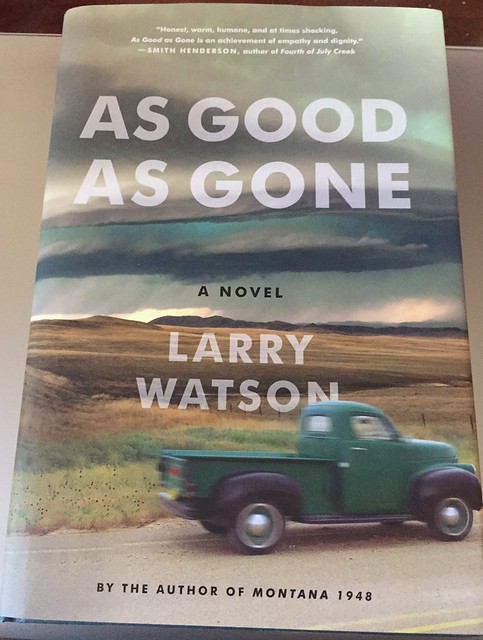
(my photo)
This is an Early Reviewers book, which I received from Algonquin Books, asking nothing but an honest review.
I enjoyed the storyline and the characters, got really involved in it, and kept reading to see what would happen. I did not much care for the strong language and sexuality, but the language was in keeping with the nature of the characters.
A tough, rangy old cowboy, now living almost as a hermit, is asked by his son to come stay with his grandchildren, who are strangers to him, for a few days while the son takes his wife to another city for surgery. The town, which as a former real estate agent, he helped build has also become strange to him, but the widow next door remembers him well.
His son and daughter-in-law have left some situations unresolved, and as attention is needed to sort them out, "Grandpa" delves in with knife and pistol and fists and tries to settle them the old-fashioned cowboy way.
Tuesday, June 7, 2016
The Naturalist: Theodore Roosevelt, A Lifetime of Exploration, and the Triumph of American Natural History

This is a book that I requested and received from LibraryThing's Early Reviewer program.
I have mixed feelings about this book. I requested it, thinking it was simply a biography of a U.S. president I had admired, but knew little about. I found his life story interesting, his poor health as a young child and his hard work to make himself fit and well, and his early fascination with the study of animals. I admire him for his work to promote conservation of natural resources and of wildlife, but the unending accounts of killing grizzlies, bison, elephants, hippos and rhinos were distressing to me. I note one quote from the book in particular, a narrative on hunting hippos: "As Roosevelt later pointed out, the cow's (female hippo) object may have been as benign as an escape to deeper water, but its wide-open jaws seemed to indicate that it was 'bent on mischief.' " Seemed like Roosevelt was the one bent on mischief; the hippos were minding their own business. I confess, I am one of the "mushy sentimentalists" like those deplored by Mr. Roosevelt. That said, his legacy cannot be denied, that of natural history and of conservation.
Since writing this review, last night (June 7) I enjoyed watching a Nova episode on PBS (American public television) titled "Wild Ways". It was about modern methods of studying and conserving wildlife: tracking animals with GPS enabled collars, and trying to open up corridors for migration. Very interesting and encouraging!
Tuesday, May 10, 2016
Cloud Atlas, by David Mitchell
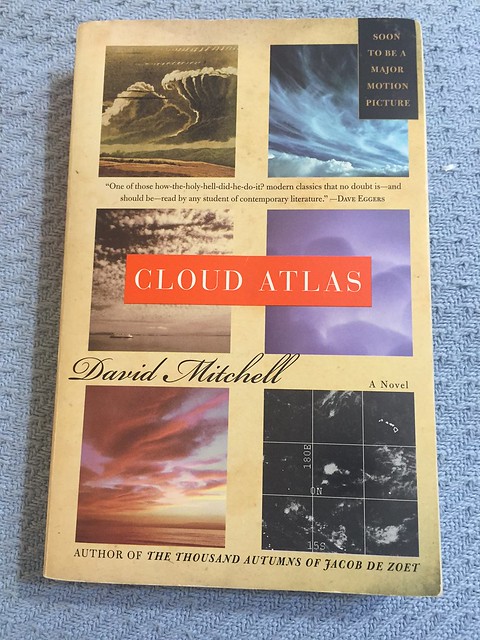
(my photo)
I had this book a year before I started reading it, and once I started, it was not easy going. It took me several weeks growing into a couple of months to finish, and several pages of notes, just to keep characters and plot turns straight.
Not my usual genre, but a very intriguing book; in fact, a sort of collection of six books, about six different sets of characters in six different places and periods of time, loosely connected by a strange comet shaped birthmark and by various references to one another.
Beginning as a 17th century travel journal of trading and missionary endeavors in the south Pacific, then a collection of letters from a British exile in 1931 Belgium, to an account of investigative journalism involving trade secrets and death threats surrounding a nuclear energy plant in California, to the tragi-comic events that befall a London book publisher, to a far-off future interview of a servant class clone in a dystopian, post-apocalyptic Korea, to an even more distant post-apocalyptic future setting in Hawaii, then back down through the other settings in reverse order.
The themes of greed, world domination, slavery, belief in reincarnation, and hope predominate. Speaking of ancient civilizations, Meronym of the Prescients teaches Zachry (in Hawaii), "Old'Uns tripped their own fall." Hae-Joo Im declares, "Neo So Copros (future Korea) is poisoning itself." In Belgium, M. Dhondt philophosizes, "Another war is always coming...What sparks wars? The will to power..the threat of violence, the fear of violence or actual violence is the instrument of this dreadful will...The nation-state is merely human nature inflated to monstrous proportions. QED, nations are entities whose laws are written by violence." Near the end of his Pacific Journal, Adam Ewing writes, "...one fine day, a purely predatory world shall consume itself. Yes, the Devil shall take the hindmost until the foremost is the hindmost. In an individual, selfishness uglifies the soul, for the human species, selfishness is extinction." But hope endures; Adam also writes, "If we believe that humanity may transcend tooth & claw, ...divers races & creeds can share this world..., if we believe leaders must be just, violence muzzled, power accountable & the riches of the Earth & its Oceans shared equitably, such a world will come to pass."
Monday, March 21, 2016
North of Boston, by Elisabeth Elo

This was an early reviewer book that I found in a Little Free Library almost a year ago. I have no idea who left it there, or whether it was a fellow LibraryThing reader or not. A paperback in good condition.
It was an exciting book, and I enjoyed it, but I would have enjoyed it more without the strong language and occasional "adult" situations.
It begins a few days after the seemingly miraculous and medically unexplainable survival of the protagonist, Pirio Kasparov, in near freezing ocean water for hours after a shipwreck. Pirio sets about sleuthing the circumstances of the wreck, interrupted by her duty to her country in allowing herself to be tested at the Navy Experimental Diving Unit in Panama City, Florida.
One of the challenges to her detective work is determining who is friend and who is foe. Is a former boyfriend, an old flame, on her side or against her? What about the shady stranger who can't tell the truth about why he attended the funeral and wake for Pirio's partner at sea who died in the collision?
Suspense builds as Pirio is kidnapped, and it looks like the end is near.
Thursday, March 3, 2016
Fire and the Hammer, by Shirley Barker
(my photo)
A romantic love story set in the uncertain and violent days of the American Revolutionary War.
Lass Marvayne of Newburyport, Massachusetts, daughter of a merchant captain, is expected to marry Crispen Corey, her father's right-hand man and former apprentice. A visit to her married sister in Pennsylvania changed her life completely when she met and fell in love with Mahlon Doan, the youngest of five Doan brothers.(The Doan brothers were hsitorical figures: Doan Outlaws ) Of a Quaker family, the brothers felt called to reject their tradition of peace, to fight against the American pull toward freedom from England. They stole horses for the British, and as time went on, they became more and more violent.
More information about the historical Doans: The Doan Outlaws of Bucks County
Friday, February 19, 2016
Oscar winning movies adapted from literature
Abe Books' website currently has a link to The Oscars Library on their homepage.
"More than two thirds of Hollywood's Best Picture winners were inspired by literature, whether it be a novel, biography, play, or short story. In fact, since the inaugural Academy Awards in 1928, exactly 62 Best Picture winners derive from literature" that is, up to 2015. "Of the 2016 nominees, six of the eight films nominated for Best Picture are based on books."
I have read many of the books on the list, and seen many of the movies. The instances in which I've seen and read the book/movie combination are few. There are many more that I want to see/read.
Here are my lists:
First, the books and movies of 2016 that I want to read and/or see:
Brooklyn by Colm Toibin
Room by Emma Donoghue (not sure about this one; it sounds creepy)
Bridge of Spies by Giles Whittell
This one was nominated for Best Actor/Actress:
Carol by Patricia Highsmith
Second, award winning movies based on books that I want to see: (you might be amazed at ones I haven't already seen; I am not much of a movie-goer)
Slumdog Millionaire, 2008
A Beautiful Mind, 2001 (I liked Russel Crowe in Les Miserables.)
Shakespeare in Love, 1998
The English Patient, 1996
Forrest Gump, 1994
Schindler's List, 1993
Out of Africa, 1985
Amadeus, 1984
Kramer vs. Kramer, 1979
One Flew Over the Cuckoo's Nest, 1975
Ben-Hur, 1959 (again - I saw it once, when I was a teenager. I didn't understand it; it was confusing to me. I want to read the book, then see the movie again.)
From Here to Eternity, 1953
All About Eve, 1950
Gentleman's Agreement, 1947
The Best Years of Our Lives, 1946
Going My Way, 1944
*Mrs. Miniver, 1942
How Green Was My Valley, 1941
*Rebecca, 1940
You Can't Take it With You, 1938 (James Stewart was in this one; another major reason to see it!)
Cavalcade, 1932/33
Grand Hotel, 1931/32
Cimarron, 1930/31
* indicates that I have read the book
Third, books made into movies that I want to read:
12 Years a Slave, by Solomon Northup in 1853 (movie made in 2013)
Q & A, by Vikas Swarup in 2005 (movie Slumdog Millionaire made in 2008)
A Beautiful Mind, by Sylvia Nasar in 1998 (movie made in 2001) ( I want to also read The Essential John Nash written by John Nash.)
The English Patient, by Michael Ondaatje in 1992 (movie in 1996)
Forrest Gump, by Winston Groom in 1986 (movie in 1994. Winston Groom's mother was an English teacher in my high school!)
Schindler's Ark, by Thomas Keneally in 1982 (movie, Schindler's List in 1993)
Out of Africa, by Karen Blixen in 1937 (movie in 1985)
Kramer vs. Kramer, by Avery Corman in 1977 (movie in 1979)
One Flew Over the Cuckoo's Nest, by Ken Kesey in 1962 (movie in 1975)
*In the Heat of the Night, by John Ball in 1965 (movie in 1967 - I have seen the movie, but wouldn't mind seeing it again.)
*Gigi, by Colette in 1944 (movie in 1958)
A Gentleman's Agreement, by Laura Z. Hobson in 1947 (movie, Gentlemen's Agreement, also in 1947)
How Green Was My Valley, by Richard Llewellyn in 1939 (movie in 1941) I read the book, or started it, when I was a teenager. I couldn't get into it; I'd like to try again.
Cimarron, by Edna Ferber in 1930 (movie in 1930/31) I have read other books by Edna Ferber and enjoyed them all.
* indicates that I have seen the movie
Fourth, Award-winning movies based on books that I have seen:
Dances With Wolves
Driving Miss Daisy
Rain Man
In the Heat of the Night
The Sound of Music
My Fair Lady
West Side Story
Ben-Hur (As I said, it was confusing; I should see it again.)
Gigi (I should see it again; all I remember is Maurice Chevalier singing "Gigi". The tune is in my head, but I can't remember the words.)
Around the World in 80 Days
Gone With the Wind
It Happened One Night
Fifth, books I have read that inspired award-winning movies:
Romeo and Juliet, play by William Shakespeare circa 1595. Both "West Side Story" and "Shakespeare in Love" were based on it.
Oliver Twist, by Charles Dickens in 1839, inspired the musical Oliver!
A Man for All Seasons, a play by Robert Bolt in 1960, on the life of Sir Thomas More, who was executed for refusing to allow King Henry VIII's divorce.
Hamlet, play by William Shakespeare, circa 1602
Mrs. Miniver, by Jan Struther in 1939
Rebecca, by Daphne du Maurier in 1938
Gone With the Wind, by Margaret Mitchell in 1936
Clearly, I have some more reading and watching ahead of me!
"More than two thirds of Hollywood's Best Picture winners were inspired by literature, whether it be a novel, biography, play, or short story. In fact, since the inaugural Academy Awards in 1928, exactly 62 Best Picture winners derive from literature" that is, up to 2015. "Of the 2016 nominees, six of the eight films nominated for Best Picture are based on books."
I have read many of the books on the list, and seen many of the movies. The instances in which I've seen and read the book/movie combination are few. There are many more that I want to see/read.
Here are my lists:
First, the books and movies of 2016 that I want to read and/or see:
Brooklyn by Colm Toibin
Room by Emma Donoghue (not sure about this one; it sounds creepy)
Bridge of Spies by Giles Whittell
This one was nominated for Best Actor/Actress:
Carol by Patricia Highsmith
Second, award winning movies based on books that I want to see: (you might be amazed at ones I haven't already seen; I am not much of a movie-goer)
Slumdog Millionaire, 2008
A Beautiful Mind, 2001 (I liked Russel Crowe in Les Miserables.)
Shakespeare in Love, 1998
The English Patient, 1996
Forrest Gump, 1994
Schindler's List, 1993
Out of Africa, 1985
Amadeus, 1984
Kramer vs. Kramer, 1979
One Flew Over the Cuckoo's Nest, 1975
Ben-Hur, 1959 (again - I saw it once, when I was a teenager. I didn't understand it; it was confusing to me. I want to read the book, then see the movie again.)
From Here to Eternity, 1953
All About Eve, 1950
Gentleman's Agreement, 1947
The Best Years of Our Lives, 1946
Going My Way, 1944
*Mrs. Miniver, 1942
How Green Was My Valley, 1941
*Rebecca, 1940
You Can't Take it With You, 1938 (James Stewart was in this one; another major reason to see it!)
Cavalcade, 1932/33
Grand Hotel, 1931/32
Cimarron, 1930/31
* indicates that I have read the book
Third, books made into movies that I want to read:
12 Years a Slave, by Solomon Northup in 1853 (movie made in 2013)
Q & A, by Vikas Swarup in 2005 (movie Slumdog Millionaire made in 2008)
A Beautiful Mind, by Sylvia Nasar in 1998 (movie made in 2001) ( I want to also read The Essential John Nash written by John Nash.)
The English Patient, by Michael Ondaatje in 1992 (movie in 1996)
Forrest Gump, by Winston Groom in 1986 (movie in 1994. Winston Groom's mother was an English teacher in my high school!)
Schindler's Ark, by Thomas Keneally in 1982 (movie, Schindler's List in 1993)
Out of Africa, by Karen Blixen in 1937 (movie in 1985)
Kramer vs. Kramer, by Avery Corman in 1977 (movie in 1979)
One Flew Over the Cuckoo's Nest, by Ken Kesey in 1962 (movie in 1975)
*In the Heat of the Night, by John Ball in 1965 (movie in 1967 - I have seen the movie, but wouldn't mind seeing it again.)
*Gigi, by Colette in 1944 (movie in 1958)
A Gentleman's Agreement, by Laura Z. Hobson in 1947 (movie, Gentlemen's Agreement, also in 1947)
How Green Was My Valley, by Richard Llewellyn in 1939 (movie in 1941) I read the book, or started it, when I was a teenager. I couldn't get into it; I'd like to try again.
Cimarron, by Edna Ferber in 1930 (movie in 1930/31) I have read other books by Edna Ferber and enjoyed them all.
* indicates that I have seen the movie
Fourth, Award-winning movies based on books that I have seen:
Dances With Wolves
Driving Miss Daisy
Rain Man
In the Heat of the Night
The Sound of Music
My Fair Lady
West Side Story
Ben-Hur (As I said, it was confusing; I should see it again.)
Gigi (I should see it again; all I remember is Maurice Chevalier singing "Gigi". The tune is in my head, but I can't remember the words.)
Around the World in 80 Days
Gone With the Wind
It Happened One Night
Fifth, books I have read that inspired award-winning movies:
Romeo and Juliet, play by William Shakespeare circa 1595. Both "West Side Story" and "Shakespeare in Love" were based on it.
Oliver Twist, by Charles Dickens in 1839, inspired the musical Oliver!
A Man for All Seasons, a play by Robert Bolt in 1960, on the life of Sir Thomas More, who was executed for refusing to allow King Henry VIII's divorce.
Hamlet, play by William Shakespeare, circa 1602
Mrs. Miniver, by Jan Struther in 1939
Rebecca, by Daphne du Maurier in 1938
Gone With the Wind, by Margaret Mitchell in 1936
Clearly, I have some more reading and watching ahead of me!
Thursday, February 4, 2016
And After Many Days, by Jowhor Ile

This book was sent to me as part of LibraryThing's Early Reviewer program. In return, I was asked to write an honest review of my own opinion of the book.
This was a very absorbing book, a slow, descriptive narrative in parts, but at the same time, a thrilling plot that kept me reading, anxious to learn what happened to the 17 year old brother, the good-humored, peace-keeping elder brother who suddenly disappeared one summer afternoon.
The author, a native of Nigeria, took us back to the early childhood of the three children of the Utu family, familiarizing us with the thriving city of Port Harcourt, Nigeria's capital city, as well as the family's ancestral village of Ogibah.
"One rarely finds ‘page-turner’ and ‘poetry’ in the same sentence, but And After Many Days is a rarity indeed…An achingly tender portrait of family life, a brilliantly executed whodunnit, a searing critique of Nigerian politics, a meditation on love. The Utu family will stay with me always."
—Taiye Selasi, author of Ghana Must Go
Tuesday, January 19, 2016
The Poisonwood Bible, by Barbara Kingsolver
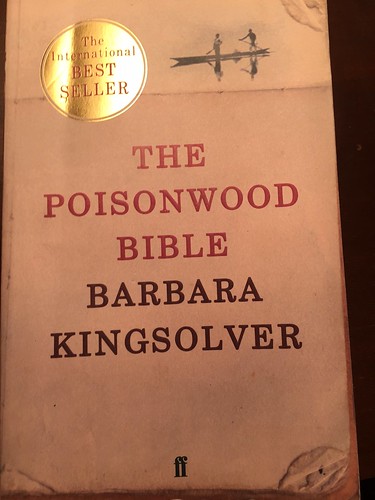
What a book! Wow! I didn't think I would be interested in it (I had put it off for nearly a year), but I couldn't be more mistaken.
A wonderful book, a family saga of a missionary venture in darkest Africa gone wrong, told through the voices of the missionary's wife and each of his four daughters.
In 1959, a wild-eyed, fiercely evangelistic Baptist preacher and his family set up housekeeping in a village of the Belgian Congo, bent on converting the people, baptizing them in the Kwilu River. Rev. Price was the kind of missionary who gives Christians a bad name. Neither teaching nor demonstrating the love of Christ, he butchers the native tongue, saying "poisonwood" when he means "precious" for example, and insists on baptizing the children in the crocodile-infested river, in which no one even dares to wade.
Many disasters occur, most of them natural: floods, famine, and invasion of army ants. The village peacefully revolts against the foreign religion of the American, and, due to violent political revolution elsewhere in Belgian Congo as well as in other African nations, the Prices are urged by the missionary society to return to America, and their funding disappears. Nevertheless, Rev. Price stubbornly remains, holding church, but no one comes except his family. If it weren't for a few friends in the village who supported the wife and daughters, the family wouldn't make it.
It takes a devastatingly tragic event to cause the wife and daughters to leave Rev. Price. The rest of the novel follows their lives as they grow to adulthood and go their separate ways. The last chapter is surprisingly touching and bittersweet.
Favorite characters: Adah, Anatole, Mama Mwanza, Brother Fowles
Least favorite: Rev. Price, Rachel as an adult, Mr. Axelroot
Memorable quotes: from Adah, the handicapped daughter, "The arrogance of the able-bodied is staggering. Yes, maybe we'd like to be able to get places quickly, and carry things in both hands. ... We would rather be just like us, and have that be all right." page 559
Leah, speaking of the effects of war on a society, "In our village there are very few boys of an age to climb trees for birds' nests, or girls stomping down the road with a sibling clutched sideways like an oversized rag doll. I notice their absence everywhere. The war cost most of its lives among children under ten. That great quiet void is moving slowly upward through us. A war leaves holes in so much more than the dams and roads that can be rebuilt." page 592
Sunday, January 17, 2016
Disappointed in Random House/UPS
Today, Sunday, I found my latest Early Reviewer book from LibraryThing in my yard, damp. Here is the "review" I wrote for LibraryThing:
This book was in my yard, damp after having been in the rain as it was thrown over the fence by the carrier, UPS. It was in cardboard-reinforced manila envelope - no plastic liner, no bubble wrap, which would have protected it from the rain. We do have a gate, which was locked, and the carrier could not have come to the door nor rung the doorbell. He/she could have taken it back to the local distribution center and called me later, or sent a message through the mail to call UPS.
Right now, the book is on my drying rack in our garage. I am almost finished with the book I am currently reading, and hope this one will dry soon so I can start reading it.
I am looking forward to it, after it is dry. It will be my second book in a row about a country in Africa, as I am almost finished The Poisonwood Bible by Barbara Kingsolver, set in Congo. I have previously read and enjoyed a few of the Ladies Detective books by Alexander McCall Smith about Mma Ramotswe of Botswana, and Manor House by Johannes Meintjes, set in South Africa. Oh, and I almost forgot that A Change in Altitude by Anita Shreve was set in Kenya. So that's half a dozen books about, or set in Africa.
This will be the second one written by a native of the continent; Jowhor Ile is Nigerian, and Johannes Meintjes was South African.
This book was in my yard, damp after having been in the rain as it was thrown over the fence by the carrier, UPS. It was in cardboard-reinforced manila envelope - no plastic liner, no bubble wrap, which would have protected it from the rain. We do have a gate, which was locked, and the carrier could not have come to the door nor rung the doorbell. He/she could have taken it back to the local distribution center and called me later, or sent a message through the mail to call UPS.
Right now, the book is on my drying rack in our garage. I am almost finished with the book I am currently reading, and hope this one will dry soon so I can start reading it.
I am looking forward to it, after it is dry. It will be my second book in a row about a country in Africa, as I am almost finished The Poisonwood Bible by Barbara Kingsolver, set in Congo. I have previously read and enjoyed a few of the Ladies Detective books by Alexander McCall Smith about Mma Ramotswe of Botswana, and Manor House by Johannes Meintjes, set in South Africa. Oh, and I almost forgot that A Change in Altitude by Anita Shreve was set in Kenya. So that's half a dozen books about, or set in Africa.
This will be the second one written by a native of the continent; Jowhor Ile is Nigerian, and Johannes Meintjes was South African.
Friday, January 15, 2016
Reading The Poisonwood Bible by Barbara Kingsolver now
A powerful book! Review to come soon; I'm almost finished.
Sunday, December 27, 2015
Family Pictures, by Jane Green

This was a very enjoyable, thought-provoking book, except for the explicit sexual descriptions (I admit I am a prude). There were some errors in context that were mildly annoying, but I could get past them. I could predict from the blurb what was going to happen, and was just waiting for it to "hit the fan." It did, very explosively, and devastatingly, utterly wrecking the lives of two families. How the women managed to pull themselves and their children out of the pit made interesting reading.
The Watsons Go To Birmingham, by Christopher Paul Curtis

An award winning children's/young adult story about a typical African American family of the upper midwest who travel to Alabama to visit relatives before a fateful September Sunday. Mr. Curtis very skillfully blends humor with tragedy.
Saturday, December 19, 2015
Evergreen, by Belva Plain
Having finished and enjoyed one Belva Plain book, I was eager to read another.
A great family saga, following Anna Friedman from her childhood in a 19th century Polish village through her immigration to America. Anna's life encompasses World Wars I and II, marriage, family, the depression, her husband's successful business, and many tragedies and joys.She lives to see grandchildren and a great granddaughter some fifty-odd years after her arrival.
Ever since her service as a maid in the Werner household, Anna has kept her attraction to the handsome young son of the family to herself, and after an incident several years later, she has even more devastating secrets to keep.
A great family saga, following Anna Friedman from her childhood in a 19th century Polish village through her immigration to America. Anna's life encompasses World Wars I and II, marriage, family, the depression, her husband's successful business, and many tragedies and joys.She lives to see grandchildren and a great granddaughter some fifty-odd years after her arrival.
Ever since her service as a maid in the Werner household, Anna has kept her attraction to the handsome young son of the family to herself, and after an incident several years later, she has even more devastating secrets to keep.
Monday, December 7, 2015
Whispers, by Belva Plain

Whispers and rumors abound, in the home and among friends and neighbors. Lies and cover-ups, to oneself, to children and other family members, to friends and neighbors. Finally, abruptly, and dramatically, it all must come out. A story of domestic violence, told very skillfully. This was not a pleasant book to read, but it kept me enthralled to the end.
Subscribe to:
Posts (Atom)