Showing posts with label coming of age. Show all posts

Tuesday, January 19, 2016

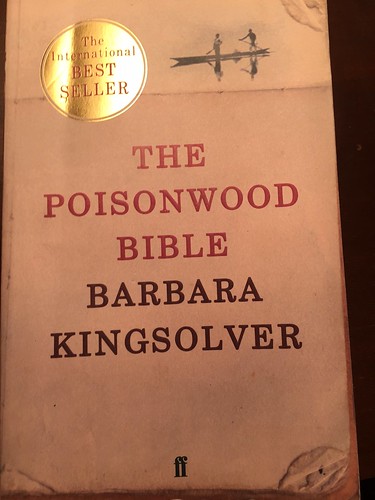
The Poisonwood Bible, by Barbara Kingsolver

Pic for book review

What a book! Wow! I didn't think I would be interested in it (I had put it off for nearly a year), but I couldn't be more mistaken.
A wonderful book, a family saga of a missionary venture in darkest Africa gone wrong, told through the voices of the missionary's wife and each of his four daughters.
In 1959, a wild-eyed, fiercely evangelistic Baptist preacher and his family set up housekeeping in a village of the Belgian Congo, bent on converting the people, baptizing them in the Kwilu River. Rev. Price was the kind of missionary who gives Christians a bad name. Neither teaching nor demonstrating the love of Christ, he butchers the native tongue, saying "poisonwood" when he means "precious" for example, and insists on baptizing the children in the crocodile-infested river, in which no one even dares to wade.
Many disasters occur, most of them natural: floods, famine, and invasion of army ants. The village peacefully revolts against the foreign religion of the American, and, due to violent political revolution elsewhere in Belgian Congo as well as in other African nations, the Prices are urged by the missionary society to return to America, and their funding disappears. Nevertheless, Rev. Price stubbornly remains, holding church, but no one comes except his family. If it weren't for a few friends in the village who supported the wife and daughters, the family wouldn't make it.
It takes a devastatingly tragic event to cause the wife and daughters to leave Rev. Price. The rest of the novel follows their lives as they grow to adulthood and go their separate ways. The last chapter is surprisingly touching and bittersweet.

Favorite characters: Adah, Anatole, Mama Mwanza, Brother Fowles
Least favorite: Rev. Price, Rachel as an adult, Mr. Axelroot

Memorable quotes: from Adah, the handicapped daughter, "The arrogance of the able-bodied is staggering. Yes, maybe we'd like to be able to get places quickly, and carry things in both hands. ... We would rather be just like us, and have that be all right." page 559

Leah, speaking of the effects of war on a society, "In our village there are very few boys of an age to climb trees for birds' nests, or girls stomping down the road with a sibling clutched sideways like an oversized rag doll. I notice their absence everywhere. The war cost most of its lives among children under ten. That great quiet void is moving slowly upward through us. A war leaves holes in so much more than the dams and roads that can be rebuilt." page 592

Thursday, July 9, 2015

The Secret Life of Bees, by Sue Monk Kidd


Read, reviewed, and released April-May, 2014

A story of a motherless girl mistreated by her father. Her odyssey with her "nanny" reminded me a little of Huckleberry Finn and Jim. With her only clue a picture on a honey jar label, Lily and Rosaleen manage to find a safe refuge among a family of three African American sisters who keep bees and make honey. There is much interesting information about bees, bee-keeping, and honey. Surprisingly, Lily also finds answers to the mysteries surrounding her own family.

Monday, July 6, 2015

Peachtree Road, by Anne Rivers Siddons


Read, reviewed, and released in December, 2013

A sad, dark novel of family dysfunction, domestic violence, and insanity in a well-bred Southern family of the Buckhead neighborhood of Atlanta, Georgia spanning from the early 1950s to the 1970s and 80s.

Shep, a middle aged man who describes himself as a recluse and a hermit reflects on his childhood at the burial of his cousin Lucy. He and Lucy bonded as friends and confidants from the moment she moved into his family home when she was five years old and he was seven. The novel carries us through the adventures of their childhood, the risks of adolescence, and the angst of early adulthood, along with that of their families and close friends.
The fact that Lucy died is no spoiler, as the Prologue opens with her funeral. How she died is the surprise, and Shep's fate remains a mystery.

Tuesday, June 16, 2015

Off Season, by Anne Rivers Siddons

Read and reviewed in January, 2011. Given away later.


Just finished this book this morning. It was a strange book, a fictional memoir of a woman's childhood and teen years, her family and her loves. It became a sort of ghost story, but not a scary one. Just strange, weird!

The Kite Runner, by Khaled Hosseini


Book image courtesy of Google Books

Read and reviewed in December, 2007. Released January, 2008.

Complex family relationships, father/son conflict, childhood betrayal, guilt, political uprising, love, marriage and infertility - and I'm only halfway through! I didn't think I'd like this book; the subject matter didn't look appealing, but it has gotten so many positive reviews and I heard the movie discussed on NPR. Now I'm glad I asked time-traveler for it. It's very well written, and hard to put down.


Fascinating book! An intimate coming-of-age story of two boys in pre-war Afghanistan. One wronged the other and later, as an adult, tried to atone for his past, and embarked on an epic-style quest, all against the background of social and political upheaval: a coup, the Russian-Afghanistan war, the rising of the Taliban, and the attacks against the United States on September 11, 2001. These news-worthy events were minor to the plot of the story, though. Central to the plot were racial and class differences between the Pashtuns and the Hazaras, very similar to that between American whites and blacks before the Civil Rights victories of the late 1960s and 1970s.


Here are some interesting quotes from the book:
These seemed ironic, as if he were really talking about The Kite Runner:
"Sad stories make good books."

"I finished my first novel, a father-son story set in Kabul ..."

These emphasize that people the world over are more alike than different:
"Take two Afghans who've never met, put them in a room for ten minutes, and they'll figure out how they're related."

"You can take Afghans out of Paghman, but you can't take Paghman out of Afghans."