Saturday, October 31, 2015

90 Minutes in Heaven, by Don Piper with Cecil Murphey


I borrowed this from a friend.

A devastating road accident results in Don Piper's death, arrival at heaven's gate, and subsequent return to earthly life. He struggles with constant pain, suffering, and wondering why he was "sent back."
This is a very inspiring book for all who have lost loved ones and have reason to believe that they are indeed in "a better place", and for all who are suffering, are despondent and who are wondering what life is all about.
It is unapologetically a Christian book, written by a Baptist pastor telling of his own experiences. I found it very inspiring, and would like to buy copies of my own, to share with others.

Tuesday, October 27, 2015

The Inimitable Jeeves, by P. G. Wodehouse


A loosely connected collection of short stories featuring Jeeves and Wooster.

Don't we all wish we had a Jeeves to take care of us, to provide our every need even before we knew we needed it, and to solve all our problems and our friends' problems with ease and diplomacy? Bertie Wooster is a young man of Edwardian England, a socialite who has received a good education and seemingly is not required to work for his living. He and his friends frequently find themselves "in the soup", usually of their own making, and Bertie's valet, Jeeves, always adroitly manages to restore them to the good graces of their families. The contrast between Bertie's casual Edwardian slang ("What ho and all that rot" for example), behavior, and attitude and Jeeves' very proper, conservative manner ("Very good, sir") was part of the fun of reading this.

Saturday, October 3, 2015

The Grapes of Wrath, by John Steinbeck


I read this many years ago, but I only remember bits and pieces of it. When I saw it at a yard sale last spring, I bought it to read again. I'm glad I did. There are many gems in it.
On corporate, commercial farming: "Carbon is not a man, nor salt nor water nor calcium. He is all of these, but he is much more, much more; and the land is so much more than its analysis. ...that man who is more than his elements knows the land that is more than its analysis. But the machine man, driving a dead tractor on land he does not know and love, understands only chemistry; and he is contemptuous of the land and of himself. When the corrugated iron doors are shut, he goes home and his home is not the land."

On the Dust Bowl migration along Route 66: "The people in flight streamed out on 66 .... All day they rolled slowly along the road, and at night they stopped near water. In the day ancient leaky radiators sent up columns of steam, loose connecting rods hammered and pounded. And the men driving the trucks and the overloaded cars listened apprehensively. How far between towns? It is a terror between towns. If something breaks - well, if something breaks we camp right here ...."

The people didn't leave because of the dust. They left because huge corporations bought the land from the owners. The people no longer owned the land their ancestors had settled. Years before, they had had to borrow against it and had been unable to pay their debts. Banks owned it. Land companies owned it. Sold it for profit, and drove the sharecropping tenants out. They had high hopes of a better life in California.

The above is a partial review; I hadn't finished it then. All I can say now is that it is a very deep, rich book. A disturbing, thought-provoking book. It was well worth reading again, I'm glad I did.

Okay, I have finished it, and actually gotten my old atlas of the United States and followed their journey through Oklahoma, the Texas panhandle, New Mexico, Arizona, and into California! The town they started from, Sallisaw, OK is in the far eastern part of Oklahoma, near Ft. Smith, Arkansas.

The book told the story of the Joad family, and interspersed this with chapter-long essays on the economy of the nation, the dust bowl migration as a whole and its effect on the western states to which they migrated, and the attitudes and actions of the people they met along the way: auto dealers, who sold the "jalopies" they needed, owners and employees of gas stations and diners whom they approached for fuel, water, and even sometimes food, fellow travelers with whom they camped on the sides of roads, campground managers, sheriffs and state police. This slowed the pace somewhat, but it helped in my understanding of the immensity of the entire situation.

Thursday, October 1, 2015

The Moonstone, by Wilkie Collins


I bought this book because it was recommended by some of my friends. I tried to start it a few months ago, but distractions kept me from being able to immerse myself in it at that time, and I find that immersion is required for many of the 19th century English classics (Austen, and Dickens, for example).

This is a Bantam Classic paperback in gently used condition. The cover is a little worn and the pages are slightly yellowed with age (3rd printing, 1986). They are not marked nor dog-eared.

The Moonstone is considered the first modern detective novel, but Collins himself called it "A Romance". Certainly, it had romance in it, but the major plot revolved around the solving of the mysterious disappearance of a large diamond which had been presented to a young lady on her 18th birthday.
The story begins many centuries before, with a large golden-yellow diamond set in the forehead of an Asian Indian idol, the moon god. It is constantly watched by three Brahmin Indians, succeeding in turn by three more in each generation. It is their duty to always know where the diamond is, and if possible, to return it to its rightful place. Its turbulent history includes a curse, many wars and invasions, desecration and theft. Finally, another invading army, the British, sack and plunder the castle, and when it's all over, the diamond has been removed to England.
Two years after the Moonstone has been discovered missing from the sitting room of Miss Rachel Verinder, a family member and their lawyer decide it is worthwhile to have a written record of all the events of that evening and following. Thus we have the story, written as reports from the principals, beginning with the family's elderly and faithful servant, the butler and steward, Mr. Gabriel Betteredge. Reports are also given by Miss Clack, a "poor relation" spinster lady who is much concerned with missionary endeavors and is given to writing in excessively flowery language; by Mr. Bruff, the family's solicitor, mentioned above; by a cousin and suitor of Miss Verlinder, Franklin Blake; by physician's assistant Ezra Jennings; by the famous London detective, Sergeant Cuff; and by the family doctor, Mr. Candy.
The Epilogue consists of three more reports: by Sergeant Cuff's man, by a ship captain, and by Mr. Murthwaite, a man known to the family, who is well traveled in Asia and in Europe.
Of all the characters, I liked Mr. Betteredge best. (I'll have to re-read Robinson Crusoe now!) I also liked Ezra Jennings and Sgt. Cuff, and I learned to like Rachel Verinder. She began as a spoiled teenager, but grew to a wise, forgiving, and loving young lady. Of course, the most pitiable was poor Rosanna Spearman, who loved in vain.
There are several suspects who had motives for stealing the diamond, and I confess I was unable to guess who was the guilty party.

Sunday, September 27, 2015

One Righteous Man: Samuel Battle and the Shattering of the Color Line in New York, by Arthur Browne


I read this book in June of this year, reviewed it on LibraryThing, and was shocked to see that I hadn't cross-posted it here! I still have it in my possession; I have not yet heard from Alabama State University. I will contact them again.

A biography of Samuel Battle, the first African American police officer in New York City, in 1911, and the challenges he faced getting on the force and fighting for each promotion and honor. He faced not only racial discrimination, but also Tammany Hall and organized crime.
This is also a story of race relations in the early years of the 20th century in the United States. What surprised me: (1) that the civil rights struggle did not begin in the 1950s; it began when the first shipload of African slaves was brought to what was then called the New World, and (2) that prejudice and discrimination was and is a national problem, not only a southern problem.
This book gave a fair and balanced account of Samuel Battle's life and behavior, revealing flaws as well as his many righteous and heroic deeds. We also see his personal life, a strong, loving husband and father, a man of faith, and a leader in his neighborhood and community.
This book is well documented and well researched, relying not only on Mr. Battle's own words in a manuscript written by Langston Hughes, but also citing public records and newspapers of the day. It has an extensive Notes section, as well as a very helpful Index.
I will try to donate this book to the Alabama State University, a historically black school in my hometown of Montgomery, Alabama. Mr. Battle's story should be shared with all who are interested in racial relations and in civil rights.

Wednesday, September 23, 2015

Happy Anniversary, Alice in Wonderland!


stock photo courtesy of Abe Books

I saw this note on Abe Books' Facebook page: "Alice's Adventures in Wonderland is a book loved by many and this year it celebrates its 150th anniversary. Learn about the author, the story, the illustrators and more on AbeBooks."

On the website linked below: "Lewis Carroll's Alice's Adventures in Wonderland, a story about a curious girl who falls down a rabbit hole and discovers a magical, nonsensical world, celebrates its 150th anniversary in 2015. Read by millions of children and adults alike around the world, this iconic book has been translated into at least 97 different languages and continues to be published in various forms. "

Read more here: Abe Books celebrates Alice in Wonderland

I have to say, of all the illustrators whose works are sampled in the website, I greatly prefer the original, John Tenniel, and also the Disney version (not pictured on the site). That was the Alice I grew up with, the little blond girl with a blue dress and white pinafore!

Did you read and enjoy Alice in Wonderland and Alice Through the Looking-Glass when you were a child? Have you read it since becoming an adult? I read it as a child, loved it then, and loved it again when I read it to my children!
Happy Anniversary, Alice!

Saturday, September 12, 2015

Two books I want to read

I have discovered two books online that I would like to read.

One is an account I read on Facebook of the actions of the kind and generous citizens of Gander, Newfoundland, Canada, on September 11, 2001. Airplanes from all over the world were landing at their airport, and travelers were temporarily stranded for several days, as there were no flights into or out of the United States following the attacks.
The Day the World Came to Town

The other is from an article in The History Blog about Emily Post, When Emily Post Drove From Sea to Shining Sea .

The book is By Motor to the Golden Gate . It is available online only; it has been digitized.

Tuesday, September 8, 2015

English Fairy Tales


fairy tale image courtesy of Stock Vector Illustration, from Shutterstock, copyright lukeruk

With thanks to my friend Carrie of Reading to Know for the links.

Do you enjoy reading fairy tales for yourself or to share with children? Some of these may be more appropriate for older children, as the endings aren't always happy.

Here is one called Molly Whuppie and the Double Faced Giant Slightly reminiscent of Hansel and Gretel and Jack and the Beanstalk, but significantly different.

For more stories, see the Table of Contents on the left side of the The Baldwin Project site, linked above. One might spend a few satisfying hours on this site!

Saturday, September 5, 2015

Private Life, by Jane Smiley


This book is a novel about Margaret Mayfield Early's life, spanning the era from 1883, when she was a young girl, to 1942. Her parents remembered vividly the American Civil War, and she lived through the Spanish-American War and World Wars I and II. (To be honest, World War II had just begun when Private Life ends, but Margaret is still strong and healthy.)

At 27 years, Margaret Mayfield is not beautiful nor especially talented. Her younger sisters marry and begin rearing families. It seems that Margaret is destined to remain an old maid - until Captain Andrew Early comes along. He doesn't exactly sweep her off her feet; his interest in her seems amazingly cool and indifferent, but she accepts his proposal. He is of a respectable family; his mother is a friend of her mother and he is always well groomed, and not unattractive. He has written a book concerning his theories of the universe, which has caught everyone's attention. It is only later, much later, that Margaret discovers that he has also caught unfavorable attention from his superiors and others at the university where he taught, and was forced to leave suddenly.

Immediately after their marriage, Andrew and Margaret move to California from Missouri, where Margaret has lived all her life. Taking an interest in her new surroundings, making friends and joining women's groups, Margaret is not homesick or bored. Time passes, and their hopes for a large family of strong, lively sons is thwarted. She grows less enchanted with her husband, as unsettling truths are slowly revealed, and his overbearing personality becomes more pronounced. She finds her time at home alone, when he is at work or engrossed in his projects, are a relief.

Margaret's old friend Dora (her sister's sister-in-law) has remained a busy, single career woman, traveling all over the world as a newspaper reporter. Although it is never expressed overtly, it seems that Margaret is envious of Dora's freedom. Although, actually Margaret is surprisingly free to come and go as she pleases, for a woman of her time. Her husband purchased an automobile, but insisted that she, not he, be the one to learn to drive it. She roams all over her small city and the county, and into San Francisco, observing nature and visiting friends which include a Japanese family and a Russian ex-patriot.

The Prologue and the Epilogue take in place in 1942, after the bombing of Pearl Harbor. These sections deal with the aftermath, especially the detainment and internment of Japanese families, Margaret's friends particularly.

Monday, August 24, 2015

Night Ride Home, by Vicki Covington


I have mixed emotions about this book. It was fairly interesting to read, but none of the characters really "grabbed" me. What I liked best about it, I think, is that it was set near Birmingham, Alabama, where I lived for 34 years. I recognized many of the places, and the one trip into the city was particularly interesting for that reason.

Set in a coal mining community in Jefferson County, Alabama west of Birmingham, this is a story of the events before and during a mining disaster.

Keller is about to marry Laura, the daughter of the owners of a service station and general store, against her father's wishes. Her mother manages the store, and her father works occasionally at the nearby steel mill, but mostly just hangs around the store drinking, shooting clay pigeons, "skeets," and getting drunker and angrier by the hour. He threatens his future son-in-law with a shotgun, so they secretly delay the wedding by a day. As it turns out, the new wedding date is December 7, 1941. However, the Pearl Harbor attack and World War II are only mentioned in passing. The young man, Keller, is afraid he will have to go to war.

On Christmas Eve that year, a wall falls at the No. 3 mine, trapping Keller's father and his crew. Men work around the clock, trying to dig them out. Meanwhile, Keller's mother fulfills a singing engagement at the Catholic Church in Birmingham, and the pregnant camp prostitute goes into labor. (The identity of the baby's father is the topic of much gossip and speculation in the community.)

Vicki Covington and her husband Dennis Covington live and work in Birmingham, Alabama. Both are authors and have been newspaper columnists.

Friday, August 21, 2015

A Child Who Reads ...


This image courtesy of www.birthdaywishes.expert

"A child who reads will be an adult who thinks." I am a strong believer in reading to children, teaching them to read, and encouraging them to read. I have always loved to read. My parents read to me at bedtime. I tried to learn to read before I started school, and managed to read and write a few words. Once I started reading books on my own, there was no stopping me!

I read to my children, and enjoyed it as much as they did. Even after they were reading independently, I read books aloud to them that were a little more advanced than their reading levels, and books that they might not have chosen. I have two sons, and we read Alice in Wonderland and The Wizard of Oz, books they might have passed over, as they featured girls as lead characters.

They are grown now. One of them loves to read as much as I do. The other not so much; he prefers watching TV (as my husband does). He does read to his children, and encourages them to read, so the torch is being passed. With so many other temptations: computers, TV, Leapfrog, etc., I do hope my grandchildren will be readers. There is nothing like reading!

Friday, August 14, 2015

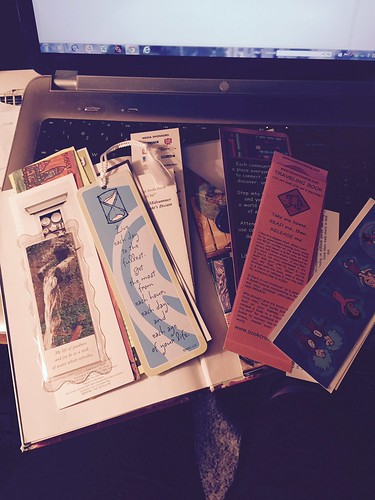
Forgotten Bookmarks, by Michael Popek


This was sent to me by another Bookcrosser as part of a bookray. There had been some discussion about it on a Bookcrossing forum.

This is a compilation of strange things people have left in books to mark their places, from the early 19th century to the present day. It includes a very brief introduction, and lots of photos, all compiled by the author, a used book dealer and blogger.

I have barely started it, and am looking forward to delving further into it. When I am finished, I will send it on to the next Bookcrosser on the list.
It comes with its own collection of bookmarks, generously supplied by the one who started the bookray, and others exchanged along the way. I have added two, and removed two.


Bookmarks

Monday, August 3, 2015

Bookish quote

"Sometimes you read a book so special that you want to carry it around with you for months after you’ve finished just to stay near it."

Markus Zusak, author of The Book Thief

(Bookish quote, seen on Bookcrossing.com)

Saturday, August 1, 2015

2 books: Watchers on the Hill, and Dangerous to Know


I finished it a few days ago. Written by Stephanie Grace Whitson, this is a Christian romance book of pioneer, ranching, and U. S. Cavalry days on the American frontier. A widow returns to her father's home to make a new life for herself and her wayward son. Romance beckons.
This book is the second in a series. While it could have stood alone successfully, there were too many annoying references to earlier times. (I have not read the first of the series.) However, it was a pleasant way to pass time.


Another romance, not Christian, written by Barbara Taylor Bradford. I started it yesterday, and am not liking the "spicy" passages. However, I probably will keep reading, just to find out who killed the old man. (Not a spoiler; we learn of his death on the first page.)

August 2 - On second thought, I won't finish it. I'll flip to the back to see how it ends, but I don't think I can swallow any more.

Sunday, July 26, 2015

Eighty-five year old man learns to read!

Lessons in Literacy, WSFA-TV news

I found this very interesting, and encouraging! Fred Oliver is the oldest person learning to read with the Literacy Council of Central Alabama! He wants to write a book about his life, and I want to read it. :-)

Mr. Oliver's advice to older people who need help learning to read: "Get out from in front of the TV and come to school," he said, then continued with, "You missed out? So you missed out. You can't reach back and get what you lost, but you can better your life at any stage."